
Hydroponic Systems: Choose the Right Way to Grow Without Soil
Growing fresh vegetables does not always require a large garden or fertile soil. Hydroponic systems make it possible to grow plants using water, nutrients, light, and a suitable growing environment. Whether you have a small balcony, rooftop, greenhouse, or commercial farm, hydroponics can help you produce fresh and healthy crops in a controlled way.
At HydroSiti, our goal is to make hydroponic farming easier to understand for beginners while also providing useful knowledge for growers who want to improve their systems.
What Is a Hydroponic System?
A hydroponic system is a method of growing plants without traditional soil. Instead of getting nutrients from soil, plants receive essential nutrients through a water-based nutrient solution.
The roots may be supported by growing media such as coco coir, clay pebbles, perlite, rockwool, or other suitable materials. Depending on the system, plant roots may be partially or completely exposed to the nutrient solution.
A well-designed hydroponic setup can give growers better control over water, nutrients, root conditions, and the growing environment.
Why Choose Hydroponic Growing?
Hydroponics is becoming increasingly popular because it can provide an efficient way to grow plants in places where traditional gardening is difficult.
1. Grow in Small Spaces
You do not need a large field to start. Hydroponic systems can be installed on balconies, terraces, rooftops, indoor spaces, or small gardens.
Vertical systems can make even better use of limited space by growing plants in multiple levels.
2. Efficient Water Use
Hydroponic systems can circulate and reuse water, particularly in recirculating designs. This can reduce water consumption compared with some traditional growing methods.
However, water efficiency depends on the system design, crop, climate, leaks, evaporation, and how well the system is maintained.
3. Better Nutrient Control
In hydroponics, growers can monitor the nutrient solution and adjust it according to the needs of the plants.
Important measurements include pH and EC (electrical conductivity). Maintaining suitable levels helps plants access nutrients effectively.
4. Cleaner Growing Environment
Because hydroponic systems do not rely on garden soil, they can reduce problems associated with soil-borne weeds and some soil-related pests and diseases.
Good hygiene is still essential. A hydroponic system is not automatically pest- or disease-free.
5. Controlled Growing Conditions
Hydroponics allows growers to control many factors, including water delivery, nutrients, lighting, temperature, humidity, and root-zone conditions.
This control can help create a more consistent growing environment.
Main Types of Hydroponic Systems
There is no single hydroponic system that is perfect for every grower. Each method has different advantages and maintenance requirements.
1. Deep Water Culture (DWC)
In Deep Water Culture, plant roots are suspended in a nutrient solution. An air pump and air stone are commonly used to supply oxygen to the water.
DWC is one of the simpler systems for beginners and can work well for leafy greens and herbs.
Best for: Beginners, lettuce, herbs, and small-scale growing.
2. Nutrient Film Technique (NFT)
In an NFT system, a thin film of nutrient solution flows through slightly sloped growing channels. Plant roots receive nutrients and water while also having access to oxygen.
NFT can be highly efficient when properly designed, but the system depends on continuous circulation.
Best for: Lettuce, leafy greens, herbs, and commercial production.
3. Drip Hydroponic System
A drip system delivers nutrient solution directly to individual plants through small tubes and emitters.
It provides growers with precise control over water and nutrient delivery and can be adapted for many different crops.
Best for: Tomatoes, cucumbers, peppers, strawberries, and larger plants.
4. Ebb and Flow
Also called a flood-and-drain system, this method periodically floods the growing area with nutrient solution and then drains it back into a reservoir.
The repeated cycle supplies the roots with water and nutrients while allowing air into the growing media between cycles.
Best for: Herbs, vegetables, and growers who want a flexible system.
5. Wick System
The wick system is one of the simplest hydroponic designs. A wick draws nutrient solution from a reservoir toward the growing medium and plant roots.
It does not normally require a water pump, making it inexpensive and easy to build.
Best for: Small plants, herbs, beginners, and simple home projects.
6. Aeroponics
Aeroponics is a more advanced technique where plant roots are suspended in air and supplied with nutrient solution as a fine mist or spray.
Because the roots receive plenty of oxygen, aeroponics can provide excellent growing conditions when the system is carefully designed and maintained.
Best for: Experienced growers, research, advanced home systems, and commercial applications.
How to Choose the Right Hydroponic System
Choosing a system should depend on your space, budget, crop, experience, and maintenance time.
If you are completely new to hydroponics, starting with DWC or a simple wick system can help you understand the basics without making the setup unnecessarily complicated.
If you want to grow leafy greens in a limited space, NFT or vertical hydroponic systems may be worth considering.
For fruiting crops such as tomatoes, cucumbers, and peppers, drip systems can provide more suitable support and nutrient delivery.
Advanced growers may prefer aeroponics because of its potential for high oxygen availability around the roots, but it generally requires more careful monitoring and reliable equipment.
What Does a Hydroponic System Need?
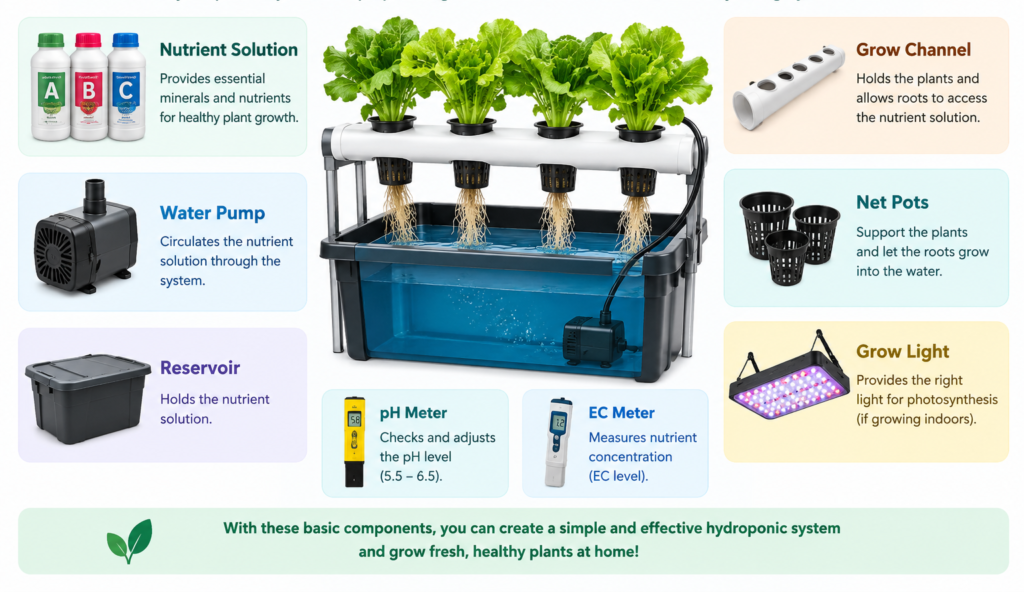
Although systems vary, most hydroponic setups require several basic components:
- A reservoir or water container
- Nutrient solution
- Growing containers or channels
- Suitable growing media
- Water pump, depending on the system
- Air pump and air stone for systems that require additional aeration
- Tubing and fittings
- Appropriate lighting for indoor growing
- pH and EC meters
- Support structures for larger plants
The goal is not to buy the most expensive equipment. A good hydroponic system should be simple, reliable, and appropriate for your crop.
Hydroponic Technology Is Making Growing Smarter
Modern hydroponic technology is changing the way growers manage plants. Timers, sensors, automated nutrient dosing, water-level monitoring, LED grow lights, and environmental controllers can reduce manual work and improve consistency.
However, technology should support good growing practices rather than replace them.
Understanding the basics of plant nutrition, water quality, root health, lighting, temperature, and sanitation is still essential.
Start Small, Learn, and Improve
One of the biggest mistakes beginners make is trying to build a complicated hydroponic farm immediately.
You do not need a huge system to begin learning.
Start with a small number of plants. Learn how your nutrient solution behaves. Monitor pH and EC. Observe the roots and leaves. Check water levels regularly. Keep the system clean and record what happens.
As your knowledge and confidence increase, you can expand your system.
Hydroponics is not simply about growing plants without soil. It is about understanding what plants need and creating an environment where those needs can be supplied efficiently.
Build Your Hydroponic Future With HydroSiti
Hydroponic farming can open new possibilities for home gardeners, hobby growers, students, entrepreneurs, and commercial farmers.
Whether you want to grow a few herbs on your balcony or explore a larger controlled-growing operation, the best place to start is with knowledge.
Explore the different hydroponic systems, understand their advantages and limitations, choose a setup that matches your goals, and learn from every growing cycle.
HydroSiti is here to help you learn hydroponics step by step—from basic systems and growing techniques to hydroponic technology and practical solutions.Start small. Grow smart. Learn continuously. And discover how much you can grow with less space and greater control.