
Grow Smarter with PVC Pipe NFT Hydroponics
If you want to grow fresh vegetables in a limited space, a PVC Pipe NFT hydroponic system can be an excellent option.
NFT stands for Nutrient Film Technique. In this system, a thin film of nutrient-rich water continuously flows through slightly sloped growing channels. Plant roots reach into the flowing solution and absorb the water and nutrients they need.
PVC pipes can be used to create affordable and space-saving growing channels, making this system popular with beginners, home growers, and small-scale hydroponic farmers.
The best part is that you can customize the system according to your available space.
What Is a PVC Pipe NFT Hydroponic System?
A PVC Pipe NFT system uses PVC pipes or specially designed channels to carry nutrient solution from a reservoir to the plants.
The basic process is:
Reservoir → Pump → PVC Growing Pipes → Nutrient Solution Flows Over Roots → Return to Reservoir
The pump moves nutrient solution from the reservoir to the higher end of the growing channels.
The pipes are installed at a slight slope so gravity allows the solution to flow toward the lower end.
The nutrient solution then returns to the reservoir, where it can be pumped through the system again.
This creates a continuous circulation system.
Why Choose PVC Pipe NFT Hydroponics?
PVC pipe systems can be useful when you want to make the most of a small growing area.
1. Space Saving
PVC pipes can be arranged horizontally, vertically, or in tiers.
This allows you to grow more plants without requiring a large amount of floor space.
A vertical arrangement can be particularly useful for balconies, rooftops, small gardens, and protected growing areas.
2. Efficient Water Use
Because the nutrient solution is recirculated, the system can use water more efficiently than traditional soil gardening.
However, water can still be lost through plant transpiration, evaporation, leaks, and system maintenance, so the reservoir should be monitored regularly.
3. Easy Plant Access
Plants can be positioned in individual holes along the pipe.
This makes it easier to inspect, harvest, and replace individual plants.
4. Clean Growing Environment
Because the plants are not growing directly in soil, you avoid many soil-related problems.
The system can also be easier to clean and organize when properly designed.
5. Customizable Design
You can build a small NFT system for a few plants or expand it into a larger setup.
The pipe diameter, number of channels, spacing, reservoir size, pump capacity, and layout can all be selected according to your growing goals.
What Can You Grow in PVC NFT Systems?
NFT systems are especially suitable for crops with relatively small root systems.
Good choices include:
- Lettuce
- Spinach
- Kale
- Basil
- Mint
- Coriander
- Pak choi
- Other leafy greens and herbs
Large fruiting plants such as tomatoes and cucumbers generally require more root support and a different system design.
If you are a beginner, lettuce and leafy greens are good crops to start with.
Materials You May Need
A basic PVC NFT system may require:
- PVC growing pipes or NFT channels
- Water reservoir
- Submersible water pump
- Net pots
- Growing medium
- Tubing
- PVC fittings
- Return pipe
- pH meter
- EC meter
- Hydroponic nutrients
- Timer or control equipment where appropriate
- Support frame or mounting structure
- Air pump and air stone if your system design requires additional aeration
The exact materials depend on the size and design of your system.
How to Build a PVC Pipe NFT System
Step 1: Plan Your Layout
Before buying materials, decide how many plants you want to grow and how much space is available.
Consider:
- Number of pipes
- Pipe length
- Plant spacing
- Height
- Reservoir location
- Pump position
- Drainage
- Access for maintenance
A good design should allow you to reach every plant and clean the system easily.
Step 2: Prepare the Growing Pipes
Create plant openings at suitable spacing along the pipes.
The holes should be large enough to hold the selected net pots securely.
Avoid making the holes unnecessarily large because the plants need stable support.
Step 3: Create a Slight Slope
NFT channels should have enough slope for the nutrient solution to flow continuously from the inlet toward the outlet.
The exact slope depends on the channel design and flow characteristics.
The goal is to create a shallow, consistent flow, rather than filling the pipe with a large volume of water.
Step 4: Install the Reservoir
Place the nutrient reservoir below the growing channels.
The reservoir should be large enough for your system and easy to access for checking water level, pH, EC, and temperature.
Use a covered or opaque reservoir where practical to help reduce light exposure and algae growth.
Step 5: Install the Pump
Place the pump inside the reservoir and connect it to the upper end of the NFT channels using suitable tubing.
The pump should provide enough flow for the complete system.
Avoid selecting a pump based only on its maximum advertised flow rate. Head height, tubing size, fittings, and system design can reduce actual flow.
Step 6: Connect the Return Line
The lower end of each growing channel should return the nutrient solution to the reservoir.
Check all connections carefully for leaks.
Before adding plants, run the system with plain water and inspect the complete flow path.
Nutrient Management
Plants need more than water.
Hydroponic nutrients provide essential elements required for plant growth.
Monitor the nutrient solution using:
pH
pH affects nutrient availability.
Many hydroponic crops prefer a mildly acidic nutrient solution, but the ideal range depends on the crop.
EC
EC, or electrical conductivity, gives an indication of the concentration of dissolved salts in the nutrient solution.
Different crops and growth stages require different nutrient strengths.
Do not use one EC value for every plant.
Follow the nutrient manufacturer’s instructions and crop-specific recommendations.
Keep the Roots Healthy
One of the biggest advantages of NFT is that roots can receive both nutrient solution and oxygen.
However, problems can occur if the system stops flowing.
A pump failure, blocked pipe, power outage, or poorly designed channel can quickly affect exposed roots.
For this reason:
- Check the pump regularly.
- Inspect tubing for blockages.
- Keep channels clean.
- Monitor the nutrient level.
- Check for leaks.
- Consider appropriate backup measures if crop loss from a power failure would be costly.
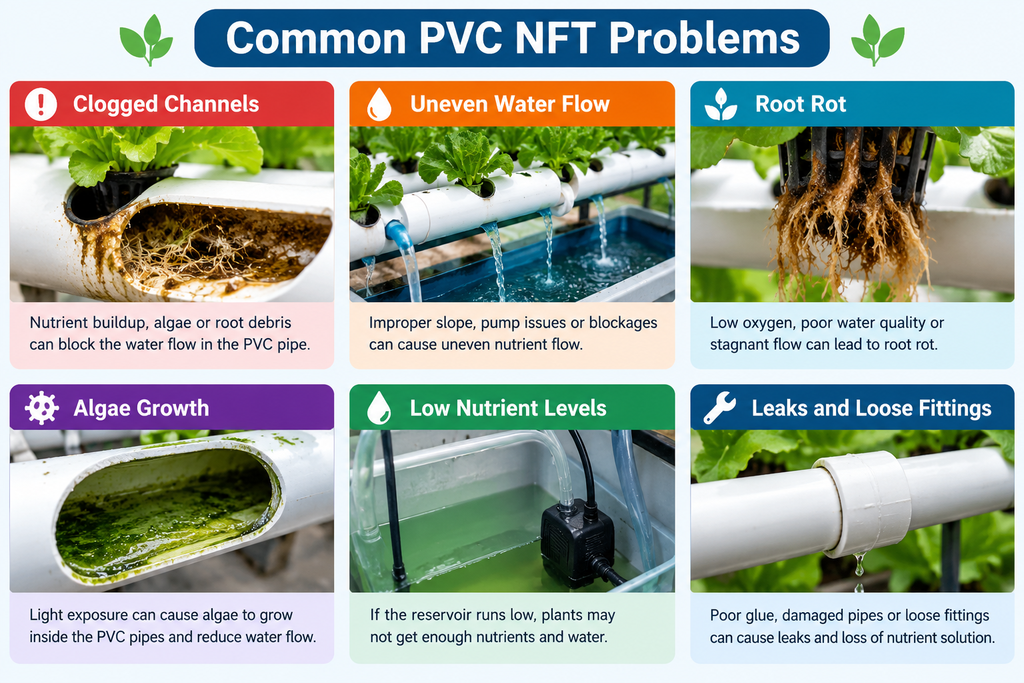
Common PVC NFT Problems
Uneven Water Flow
Some channels may receive more solution than others.
Possible causes: Incorrect pipe slope, blocked tubing, poor manifold design, or an unsuitable pump.
Root Blockage
Large root systems can restrict the flow of nutrient solution.
Regular inspection and suitable crop selection can reduce this problem.
Algae Growth
Light reaching nutrient solution can encourage algae.
Using opaque materials or reducing light exposure to the reservoir and channels can help.
Pump Failure
A failed pump can stop nutrient delivery.
Regular pump inspection and cleaning are important.
Leaks
Poorly sealed fittings can waste water and damage surrounding areas.
Test the system before planting.
How to Make Your PVC NFT System Better
If you want better long-term results, focus on system design rather than simply adding more plants.
Prioritize Good Flow
Every channel should receive an appropriate and reasonably consistent flow.
Choose the Right Crops
Leafy greens and herbs are generally easier to manage in NFT than large, heavy, fruiting plants.
Make Maintenance Easy
Design the system so you can easily reach the reservoir, pump, pipes, and plants.
Protect the Reservoir
Keep unnecessary light and debris away from the nutrient solution.
Monitor Regularly
Check your plants, water level, pH, EC, pump, and flow regularly.
Useful Hydroponic Products for Your Setup
Building an NFT system requires several basic pieces of equipment.
If you are planning your first system, you may want to compare:
Hydroponic nutrient kits – for supplying essential plant nutrients.
pH meters – for monitoring nutrient-solution acidity.
EC meters – for checking nutrient concentration.
Water pumps – for circulating nutrient solution.
Net pots – for supporting plants in the growing channels.
Grow lights – useful when natural light is insufficient for indoor growing.
Hydroponic growing media – useful for supporting seedlings and young plants.
Build Small Before Going Big
If you are new to NFT hydroponics, start with a small system.
For example, build a system for a limited number of plants and learn:
- How nutrient flow works
- How to maintain pH
- How to monitor EC
- How much water your plants consume
- How quickly roots develop
- How to clean the system
- How different crops perform
Once you understand the system, you can expand gradually.
Starting small can reduce mistakes and make troubleshooting much easier.
Is PVC Pipe NFT Hydroponics Right for You?
A PVC NFT hydroponic system can be a practical option if you want to grow plants efficiently while making good use of limited space.
Key Benefits
✔ Efficient Use of Space
Limited growing space can still accommodate several plants when PVC NFT channels are arranged efficiently. Horizontal or vertical layouts can help maximize the available area.
✔ Recirculating Nutrient Solution
Nutrient-rich water continuously flows through the channels before returning to the reservoir. This recirculating design can help reduce water waste.
✔ Easy Access to Plants
A well-positioned NFT channel makes routine plant care more convenient. Monitoring, harvesting, cleaning, and checking the roots can be easier when plants are within comfortable reach.
✔ Customizable Growing System
Different channel lengths and layouts can be used to match your available space. Growers can also adjust the number of channels according to their plant requirements.
✔ Suitable for Leafy Greens and Herbs
Lettuce, spinach, basil, mint, and other lightweight crops are commonly suited to NFT systems. Proper nutrient levels, water flow, pH, and environmental conditions are still important for healthy growth.
Regular Monitoring Is Important
Although PVC NFT systems can be simple to operate, they are not maintenance-free. Regular checks are important to keep the system running properly.
Several factors can affect plant health, including pump failure, blocked channels, incorrect nutrient concentration, poor water flow, pH problems, and unsuitable growing conditions.
The key to successful NFT growing is not just building the system. Proper maintenance, regular monitoring, and timely adjustments help keep nutrient flow consistent and plants healthy.
If you are prepared to monitor the pump, nutrient solution, water level, and plant roots regularly, a PVC Pipe NFT hydroponic system can be a useful choice for growing in limited space.
Final Thoughts
PVC Pipe NFT Hydroponics is an interesting way to grow fresh vegetables using limited space.
With a well-designed system, suitable crops, consistent nutrient flow, and regular monitoring, you can create an efficient growing environment for leafy greens and herbs.
Start simple, learn how your system behaves, and improve it as you gain experience.
Good hydroponics is not about having the most expensive equipment. It is about creating the right growing conditions and maintaining them consistently.
Recommended Next Steps
If you are planning to build your own NFT system, learn about:
Hydroponic Systems → Understand the different hydroponic methods.
pH & EC Guide → Learn how to manage your nutrient solution.
Growing Tips → Learn practical techniques for healthier plants.
Pest & Disease Control → Learn how to identify and prevent common plant problems.
Affiliate Disclosure
Some links on this page may be affiliate links. If you purchase a product through an affiliate link, HydroSiti may receive a small commission at no additional cost to you.
We aim to recommend products and equipment that can be useful for hydroponic growers. Always check the product specifications and suitability for your own growing system before purchasing.