
Hydroponic Nutrients: Complete Beginner’s Guide
A hydroponic system may not use soil, but plants still need food to grow. Instead of taking nutrients from the soil, hydroponically grown plants receive essential minerals directly from a water-based solution. This is where hydroponic nutrients become important.
If you are just starting, fertilizer bottles, NPK numbers, EC meters, pH levels, and mixing instructions can seem complicated. However, understanding hydroponic nutrients does not require advanced agricultural knowledge. Once you learn what plants need and how to monitor the growing solution, nutrient management becomes much easier.
The right hydroponic nutrients provide plants with essential elements needed for healthy roots, strong stems, green leaves, flowering, and fruit production. Different plants may require different nutrient concentrations depending on their growth stage.
Learning how to mix hydroponic nutrients correctly is an important part of maintaining a healthy hydroponic system. You also need to monitor pH and EC regularly because these measurements help you understand whether the nutrient solution is suitable for your plants.
In this beginner’s guide, you’ll learn what hydroponic nutrients are, how NPK works, why pH and EC matter, how to avoid common mistakes, and how to give your plants a healthy nutritional foundation. By understanding hydroponic nutrients, you can build a more reliable growing routine and support healthier plant growth.
What Are Hydroponic Nutrients?
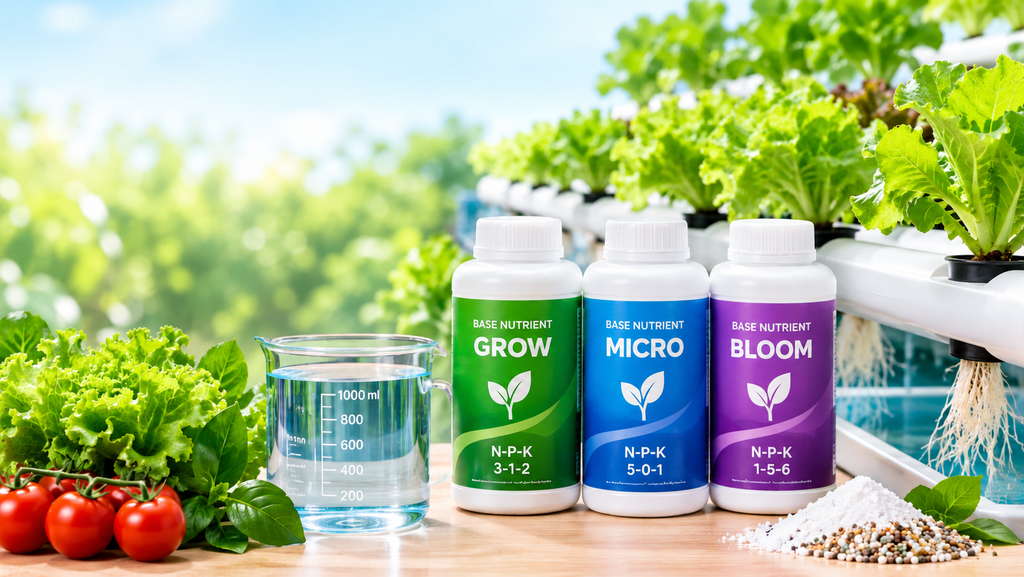
Hydroponic nutrients are concentrated fertilizers specially formulated to provide plants with the minerals they normally obtain from soil.
Because there is little or no growing soil in most hydroponic systems, the nutrient solution needs to provide the essential elements required for plant growth.
Plants need three primary nutrients in relatively large amounts:
- Nitrogen (N) – supports leafy and vegetative growth.
- Phosphorus (P) – supports root development and plays a role in flowering and fruiting.
- Potassium (K) – contributes to overall plant strength, water regulation, and crop development.
These three nutrients are commonly shown as NPK on fertilizer labels.
However, plants need much more than NPK.
Essential Nutrients Plants Need
A complete feeding program also includes secondary nutrients and micronutrients.
Secondary Nutrients
Calcium helps support cell walls and healthy new growth.
Magnesium is important for chlorophyll and photosynthesis.
Sulfur contributes to proteins and several important plant processes.
Micronutrients
Plants require smaller quantities of elements such as:
- Iron
- Manganese
- Zinc
- Copper
- Boron
- Molybdenum
- Chlorine
- Nickel
Even though plants need these elements in tiny amounts, they are still essential. A deficiency can affect growth, leaf color, roots, flowering, or fruit development.
The goal is not simply to add as much fertilizer as possible. Plants perform best when nutrients are supplied in appropriate amounts and proportions.
Understanding NPK Numbers
When you look at a fertilizer bottle, you may see something such as 3-1-6 or 5-10-5.
These numbers represent the relative percentages of nitrogen, phosphate, and potash expressed according to fertilizer-label conventions.
For example, a fertilizer with a higher first number generally contains more nitrogen relative to phosphorus and potassium.
This doesn’t mean a high-NPK product is automatically better. Different plants and different stages of growth have different nutritional requirements.
Leafy greens, herbs, tomatoes, peppers, cucumbers, and strawberries should not automatically receive the same feeding program.
Always follow the fertilizer manufacturer’s instructions and consider the specific crop you are growing.
Why pH Matters in Hydroponics
Adding fertilizer to water is only part of the job. You also need to consider pH.
pH describes how acidic or alkaline the nutrient solution is. It influences the availability of nutrients to plant roots.
If the pH moves too far outside the appropriate range, plants may have difficulty absorbing certain elements. This can sometimes create symptoms that look like a nutrient deficiency even when the nutrient is present in the reservoir.
For many common hydroponic crops, growers often maintain a mildly acidic solution, but the ideal range varies depending on the plant and growing method.
A digital pH meter can make monitoring easier. Check the manufacturer’s recommendations for your crop and nutrient system rather than trying to maintain one number for every plant.
What Is EC and Why Is It Important?
EC stands for Electrical Conductivity.
It is commonly used by hydroponic growers to estimate the concentration of dissolved salts in a nutrient solution.
In simple terms, EC helps answer an important question:
Is the nutrient solution relatively weak, or is it becoming too concentrated?
A very low EC may indicate that the solution contains insufficient dissolved nutrients for the crop. Excessively high EC can create osmotic stress and make it harder for roots to take up water.
Different crops have different preferred EC ranges. For example, leafy greens generally require less nutrient concentration than many fruiting crops.
Because water quality, plant size, temperature, crop variety, and growth stage can affect nutrient requirements, use crop-specific recommendations instead of treating one EC number as universal.
How to Mix Nutrients Correctly
One of the most important rules for beginners is simple:
Follow the fertilizer manufacturer’s mixing instructions.
Do not assume that more fertilizer means faster growth.
Start with clean water and measure the required amount of each product carefully. If you are using a multi-part fertilizer system, follow the manufacturer’s recommended order for adding the components.
Never mix concentrated fertilizer products together directly unless the manufacturer specifically says it is safe. Some concentrated ingredients can react with each other and form unwanted compounds.
After mixing, allow the solution to become uniform and check the EC and pH according to your growing method.
Common Hydroponic Nutrient Mistakes
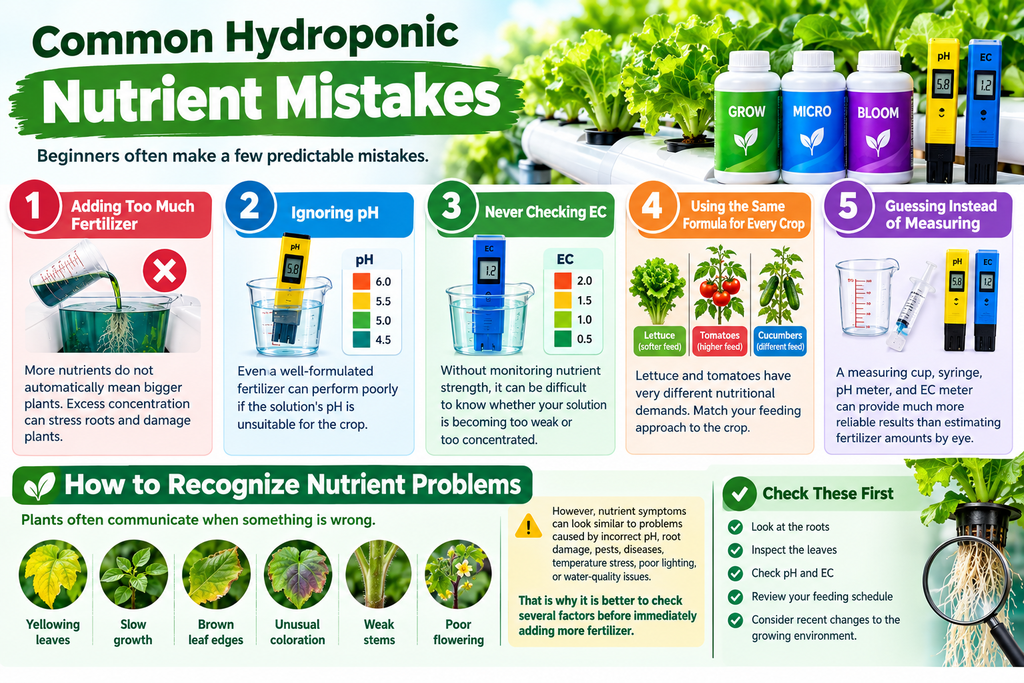
Beginners often make a few predictable mistakes.
1. Adding Too Much Fertilizer
More nutrients do not automatically mean bigger plants. Excess concentration can stress roots and damage plants.
2. Ignoring pH
Even a well-formulated fertilizer can perform poorly if the solution’s pH is unsuitable for the crop.
3. Never Checking EC
Without monitoring nutrient strength, it can be difficult to know whether your solution is becoming too weak or too concentrated.
4. Using the Same Formula for Every Crop
Lettuce and tomatoes have very different nutritional demands. Match your feeding approach to the crop.
5. Guessing Instead of Measuring
A measuring cup, syringe, pH meter, and EC meter can provide much more reliable results than estimating fertilizer amounts by eye.
How to Recognize Nutrient Problems
Plants often communicate when something is wrong.
Yellowing leaves, slow growth, brown leaf edges, unusual coloration, weak stems, or poor flowering can sometimes be associated with nutritional problems.
However, nutrient symptoms can look similar to problems caused by incorrect pH, root damage, pests, diseases, temperature stress, poor lighting, or water-quality issues.
That is why it is better to check several factors before immediately adding more fertilizer.
Look at the roots, inspect the leaves, check pH and EC, review your feeding schedule, and consider recent changes to the growing environment.
Tips for Beginners
If you are starting your first hydroponic garden, keep things simple.
Choose a reputable hydroponic fertilizer designed for your crop. Follow the label carefully, keep your reservoir clean, and monitor pH and EC regularly.
It is also helpful to keep a simple growing record. Write down when you changed the nutrient solution, the approximate EC and pH readings, and how your plants responded.
Over time, these notes can help you understand what works best in your particular system.
Final Thoughts
Understanding hydroponic nutrients doesn’t have to be difficult.
Start by learning the basics of NPK, secondary nutrients, and micronutrients. Then learn how pH affects nutrient availability and how EC helps you monitor solution strength.
Most importantly, avoid the temptation to constantly change your nutrient concentration. Consistency, observation, measurement, and good growing conditions are just as important as the fertilizer itself.
Whether you’re growing lettuce in a small indoor system, herbs on a balcony, or tomatoes in a larger Dutch Bucket setup, proper nutrition can give your plants the foundation they need to grow successfully.
Learn the basics, measure carefully, watch your plants, and improve your system one step at a time.