
In hydroponic gardening, plants do not grow in soil.Instead, their roots receive water, oxygen, and essential nutrients directly from a nutrient solution. However, because there is no soil to naturally buffer the growing environment, growers need to carefully monitor several important factors.
Among these factors, two of the most important measurements are pH and EC.
Specifically, pH tells you how acidic or alkaline your nutrient solution is, while EC (Electrical Conductivity) indicates how much dissolved nutrient salts are present in the water. Therefore, keeping both measurements within a suitable range helps plants absorb nutrients efficiently and supports healthy growth. In addition, regular monitoring can help growers identify potential nutrient problems before they affect plant health.
This guide explains what pH and EC mean, why they matter, how to measure them, and how beginners can manage them in a hydroponic system.
What Is pH in Hydroponics?
pH measures whether a solution is acidic, neutral, or alkaline.
The pH scale normally ranges from 0 to 14:
- Below 7: Acidic
- 7: Neutral
- Above 7: Alkaline
For most hydroponic plants, the nutrient solution is slightly acidic rather than neutral.
A general target for many hydroponic crops is approximately pH 5.5–6.5, although the ideal range varies depending on the plant.
For example, leafy greens often perform well around the lower-to-middle part of this range, while some other crops may prefer a slightly different level.
Why Is pH Important?
pH affects how easily plant roots can absorb different nutrients.
Even if you provide the correct amount of nutrients, plants may not be able to use them effectively if the pH is too high or too low. This can lead to nutrient deficiencies, poor growth, yellowing leaves, or other problems.
For example, an incorrect pH can reduce the availability of nutrients such as:
- Iron
- Calcium
- Magnesium
- Phosphorus
- Manganese
- Zinc
This is why hydroponic growers often describe pH as the nutrient availability control of the system.
What Happens When pH Is Too Low?
If the nutrient solution becomes excessively acidic, plants can experience nutrient-availability problems and root stress.
Possible symptoms include:
- Slow growth
- Leaf discoloration
- Root damage
- Poor nutrient absorption
- Reduced overall plant health
What Happens When pH Is Too High?
An excessively alkaline solution can make certain nutrients less available to the plant.
Common symptoms may include:
- Yellowing between leaf veins
- Slow growth
- Small or distorted new leaves
- Signs that resemble nutrient deficiencies
However, visual symptoms alone are not always enough to diagnose a pH problem. Measuring the solution is much more reliable.
What Is EC in Hydroponics?
EC stands for Electrical Conductivity.
EC measures how easily electricity passes through the nutrient solution. Dissolved mineral salts increase the solution’s electrical conductivity, so EC can be used as an indicator of the concentration of dissolved nutrients.
In simple terms:
pH tells you about nutrient availability, while EC gives you an indication of nutrient strength.
EC is commonly displayed in mS/cm (millisiemens per centimeter).
Some meters and growers may also use µS/cm or TDS/PPM readings.
Why Is EC Important?
Plants need nutrients, but more nutrients do not always mean better growth.
If EC is too low, the nutrient solution may not provide enough minerals for healthy development.
If EC is too high, the solution can become too concentrated. This can make it harder for roots to take up water and may cause nutrient stress or root-zone problems.
Therefore, the goal is not simply to achieve a high EC. The goal is to maintain an EC appropriate for the crop and its growth stage.
Typical EC Ranges for Hydroponic Crops
There is no single EC value that is perfect for every plant. Crop variety, growth stage, water quality, temperature, growing system, and nutrient formulation can all affect the ideal range.
As a general starting point:
| Crop | Approximate EC Range |
|---|---|
| Lettuce | 0.8–1.8 mS/cm |
| Spinach | 1.5–2.0 mS/cm |
| Basil | 1.0–1.6 mS/cm |
| Kale | 1.5–2.0 mS/cm |
| Strawberry | 1.0–1.8 mS/cm |
| Tomato | 2.0–3.5 mS/cm |
| Cucumber | 1.7–2.5 mS/cm |
| Pepper | 1.8–2.5 mS/cm |
These values should be treated as general starting points rather than universal rules. Always check the recommendations for your specific crop and nutrient product.
What does mS/cm mean?
mS/cm stands for millisiemens per centimeter. It is the unit commonly used to measure EC (Electrical Conductivity) in hydroponics.
pH vs EC: What Is the Difference?
pH and EC in hydroponics measure two different aspects of the nutrient solution. pH shows how acidic or alkaline the water is, while EC indicates the concentration of dissolved nutrients. Keeping both levels within the appropriate range helps plants absorb nutrients efficiently and supports healthy growth.
pH:
Measures the acidity or alkalinity of the nutrient solution.
EC:
Measures electrical conductivity and provides an indication of dissolved ionic nutrients.
Think of it this way:
pH = Can the plant access the nutrients effectively?
EC = How concentrated is the nutrient solution?
Both measurements should be monitored because a good EC does not guarantee a suitable pH, and a correct pH does not guarantee that the nutrient concentration is appropriate.
How to Measure pH
A digital pH meter is one of the most useful tools for a hydroponic grower.
Step 1: Prepare the Nutrient Solution
Add water to your reservoir and mix the nutrients according to the manufacturer’s instructions.
Step 2: Mix Thoroughly
Allow the solution to circulate or mix well before taking a reading.
Step 3: Measure the pH
Place the calibrated pH meter into the nutrient solution.
Wait until the reading stabilizes.
Step 4: Adjust if Necessary
If the pH is outside your target range, use an appropriate pH Up or pH Down product according to its instructions.
Add adjustments gradually rather than making a large correction at once.
Step 5: Recheck
Allow the solution to mix thoroughly and measure again.
Avoid repeatedly adding large amounts of pH adjustment without checking the reading.
How to Measure EC
An EC meter makes it easy to monitor nutrient concentration.
Step 1: Mix the Nutrient Solution
Make sure the nutrients are completely mixed throughout the reservoir.
Step 2: Check the EC
Place the EC meter into the solution and wait for a stable reading.
Step 3: Compare With Your Target
Compare the reading with the recommended EC range for your crop and growth stage.
Step 4: Make Small Adjustments
If EC is too low, additional nutrient solution may be required.
If EC is too high, dilution with suitable water may be necessary.
Always follow the nutrient manufacturer’s feeding instructions.
The Importance of Water Quality
Your starting water can have a major effect on hydroponic nutrient management.
Tap water may already contain minerals and salts. These contribute to the starting EC before you add any hydroponic nutrients.
For this reason, it is useful to know your source-water EC.
If your water already has a relatively high EC, adding a full-strength nutrient formula may produce a final EC that is higher than expected.
Reverse osmosis (RO) water has much lower dissolved mineral content and can provide growers with greater control over nutrient formulation, although it may require appropriate mineral supplementation depending on the nutrient system being used.
Why pH and EC Change Over Time
Do not expect your pH and EC readings to remain exactly the same.
Plants continuously absorb water and nutrients. Evaporation also changes the concentration of the solution.
For example, if plants take up more water than nutrients, EC may rise because the remaining solution becomes more concentrated.
If plants absorb nutrients faster than water, EC may decrease.
pH can also move as plants selectively absorb different nutrients and as the root-zone environment changes.
This is why regular monitoring is important.
What Does It Mean When EC Keeps Rising?
A continuously increasing EC can indicate that plants are taking up water faster than nutrients.
Possible causes include:
- High nutrient concentration
- High evaporation
- Excessive water loss
- Environmental stress
- Incorrect feeding strength
Check the reservoir level, plant condition, temperature, humidity, and nutrient concentration before making major changes.
What Does It Mean When EC Keeps Falling?
A falling EC may indicate that plants are absorbing nutrients from the solution faster than water.
Possible causes include:
- Plants actively growing
- Nutrient solution too weak
- High nutrient demand
- Incorrect nutrient balance
Do not automatically add concentrated nutrients every time EC falls. Look at the overall system and follow the nutrient manufacturer’s recommendations.
How Often Should You Check pH and EC?
The ideal monitoring frequency depends on your hydroponic system and environmental conditions.
For beginners, checking the reservoir regularly—often daily in an actively managed system—can help identify changes before they become serious problems.
Record your readings in a simple notebook or spreadsheet.
You can track:
| Date | pH | EC | Water Level | Action |
|---|---|---|---|---|
| Day 1 | 5.9 | 1.2 | Full | None |
| Day 2 | 6.1 | 1.3 | Slightly Low | Added Water |
| Day 3 | 5.8 | 1.1 | Normal | Monitored |
Keeping records helps you understand how your plants and system behave over time.
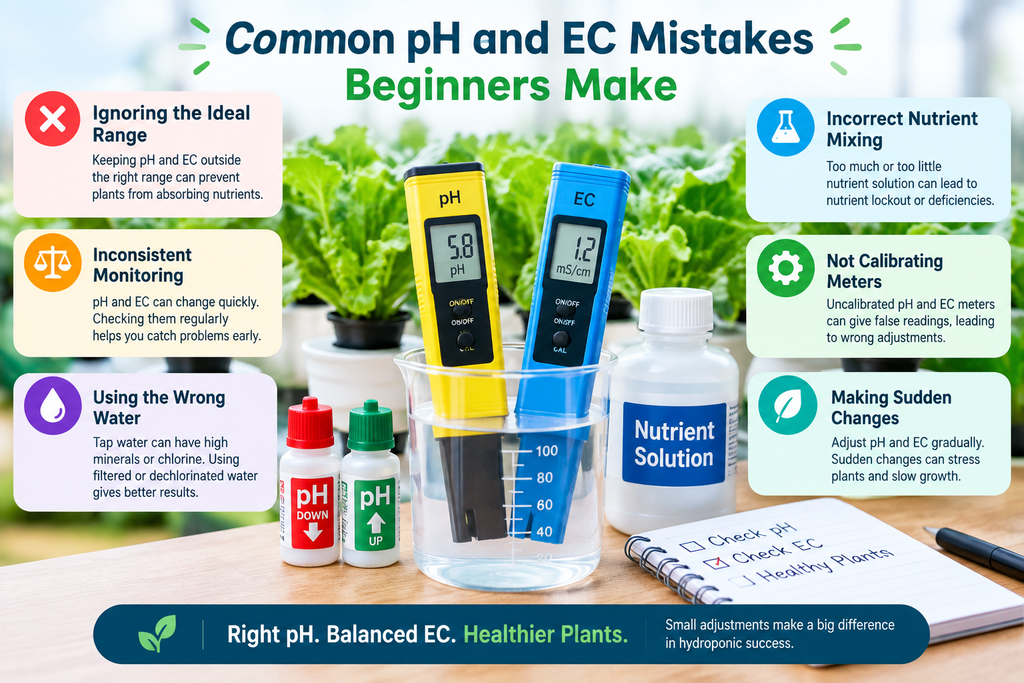
Common pH and EC Mistakes Beginners Make
1. Using an Uncalibrated pH Meter
A cheap or poorly maintained meter can provide inaccurate readings.
Calibrate your pH meter according to the manufacturer’s instructions and replace or maintain the electrode when necessary.
2. Making Large Adjustments
Adding too much pH Up, pH Down, or nutrient concentrate at once can cause the solution to move far outside the desired range.
Make small adjustments and recheck.
3. Ignoring Source Water
If you do not measure your starting water, you may misunderstand your final EC.
4. Chasing Every Small pH Change
pH naturally moves in many hydroponic systems. Trying to force the number to exactly the same value every minute can create instability.
Monitor trends and make controlled corrections.
5. Assuming Higher EC Means Faster Growth
More nutrients are not automatically better.
An excessively strong nutrient solution can stress plants and interfere with water uptake.
6. Using TDS/PPM and EC as If They Are Identical
TDS/PPM meters estimate dissolved solids using a conversion from conductivity. Different meters can use different conversion factors.
For consistency, growers should understand which scale their meter uses rather than comparing numbers from different meters as if they were identical.
How Temperature Affects EC
Temperature can influence EC readings.
Many modern EC meters include automatic temperature compensation, but it is still important to understand that conductivity changes with temperature.
When comparing readings over time, using a meter with appropriate temperature compensation can make monitoring more consistent.
A Simple pH and EC Routine for Beginners
You do not need a complicated process to start.
Follow this basic routine:
1. Check the water level.
Make sure the reservoir has enough solution.
2. Check EC.
Compare it with your crop’s target range.
3. Check pH.
Measure the nutrient solution after it has mixed properly.
4. Make small adjustments.
Avoid sudden changes.
5. Allow the system to mix.
Give the reservoir time to circulate.
6. Measure again.
Confirm that your adjustment produced the desired result.
7. Record the readings.
Tracking data helps identify trends and problems.
Final Thoughts
Understanding pH and EC is one of the most important skills for successful hydroponic gardening.
pH influences nutrient availability, while EC helps you monitor the strength of the nutrient solution. When these measurements are monitored together with water quality, temperature, plant health, and growth stage, growers can create a more stable root environment.
Remember that there is no universal pH or EC number for every hydroponic crop. Use crop-specific recommendations as your starting point, monitor your plants, and make gradual adjustments.
With consistent measurement and good record-keeping, even beginners can become much more confident managing hydroponic nutrient solutions.
Start simple: measure, record, adjust carefully, and learn how your plants respond.