
Growing hydroponic strawberries at home is a great way to enjoy fresh, juicy strawberries without traditional soil gardening. In this complete guide, you’ll learn how to choose the right hydroponic system, provide essential nutrients, maintain ideal growing conditions, and harvest delicious strawberries at home.
Hydroponic strawberry growing provides the plant with water and nutrients directly through the root zone while eliminating the need for traditional soil. With suitable light, temperature, nutrients, pollination, and regular care, you can enjoy fresh strawberries from a surprisingly small growing space.
Why Grow Strawberries Hydroponically?
Growing Hydroponic Strawberries at Home is a great way to enjoy fresh, delicious berries without using traditional soil. Strawberries grow well in hydroponic systems because their roots do not require a large amount of growing media.
One of the main benefits of growing Hydroponic Strawberries at Home is that you can control the water, nutrients, and growing conditions. This helps support healthy plant growth and can make harvesting fresh strawberries more convenient.
With the right hydroponic system and proper care, Hydroponic Strawberries at Home can be a rewarding option for beginners and experienced gardeners alike.
A hydroponic system can provide several advantages:
- No traditional garden soil is required
- Plants can be grown in limited spaces
- Water and nutrients can be carefully managed
- Plants can be grown vertically
- Fruit can be easier to monitor and harvest
- The growing environment can be controlled more easily
However, hydroponic strawberries are not completely maintenance-free. Good results depend on providing the right growing conditions.
Choose the Right Strawberry Variety
The first step is selecting a suitable strawberry variety.
For home hydroponic growing, day-neutral and everbearing varieties can be attractive choices because they can produce fruit over a longer period when environmental conditions are suitable.
Before buying plants or seeds, check the growing characteristics of the variety and make sure it is suitable for your climate and growing system.
Healthy plants are also important. Start with disease-free planting material whenever possible.
Choose a Suitable Hydroponic System
Several hydroponic systems can be adapted for strawberries.
Nutrient Film Technique (NFT)
NFT systems allow a thin stream of nutrient solution to flow along growing channels.
They can work well for strawberries when the system provides adequate root space and reliable nutrient flow.
Dutch Bucket Systems
Dutch bucket systems provide individual growing containers and can be useful for larger plants.
Vertical Hydroponic Systems
Vertical systems are useful when space is limited.
Strawberry plants can grow from different levels, allowing you to produce more plants within a relatively small footprint.
Drip Hydroponics
A drip system delivers nutrient solution directly to each plant’s growing media.
For beginners, a simple and reliable system can often be easier to manage than a highly complicated setup.
Give Strawberries Enough Light
Light is essential for strawberry growth and fruit production.
If you are growing outdoors, choose a location with suitable sunlight.
For indoor growing, quality grow lights may be necessary.
Insufficient light can lead to weak growth and poor fruit development, while excessive heat from lighting can stress plants.
When using artificial lighting, follow the manufacturer’s recommendations for installation and operating distance.
Affiliate opportunity: You can recommend grow lights that you have researched and consider suitable for home hydroponic growers.
Example:
Recommended for beginners: [Your Grow Light Affiliate Link]
Use the Right Growing Medium
Although hydroponics does not use traditional soil, many systems still use a growing medium to support the plant.
Common options include:
- Coco coir
- Perlite
- Rockwool
- Clay pebbles
- Specialized hydroponic growing media
The best choice depends on the hydroponic system you are using.
The growing medium should provide adequate support while allowing sufficient air and moisture around the roots.
Affiliate opportunity: You can recommend suitable hydroponic growing media through your affiliate program.
Shop recommended growing media → [Affiliate Link]
Pay Attention to pH and EC
Nutrient management is one of the most important parts of hydroponic strawberry production.
Two measurements you should understand are pH and EC.
pH
pH affects nutrient availability to the plant.
Strawberries generally prefer a mildly acidic root-zone environment, but the exact target can depend on the cultivar, nutrient formulation, and growing conditions.
EC
EC, or electrical conductivity, provides an indication of the concentration of dissolved salts in the nutrient solution.
Young plants and fruiting plants may have different nutrient requirements.
Do not simply use a strong nutrient solution because you want faster growth. Excessive nutrient concentration can stress plants.
Follow the nutrient manufacturer’s instructions and use crop-specific recommendations where possible.
Affiliate opportunity: A reliable pH meter and EC meter are useful tools for serious hydroponic growers.
Check recommended pH & EC meters → [Affiliate Link]
Keep the Root Zone Healthy
Healthy roots are essential for healthy strawberry plants.
The root zone should receive enough moisture and oxygen.
Avoid conditions where roots remain excessively saturated without adequate oxygenation.
Regularly inspect roots when your system allows it.
Watch for:
- Brown or unhealthy-looking roots
- Slimy roots
- Unusual smell
- Poor plant growth
- Wilting despite adequate water
Root problems should be investigated early rather than ignored.
Temperature Matters
Strawberries generally perform best under moderate temperatures rather than extreme heat.
Very high temperatures can reduce plant performance and may interfere with flowering and fruit development.
If you live in a hot climate, pay particular attention to:
- Reservoir temperature
- Air temperature
- Humidity
- Direct sunlight
- Air circulation
An inexpensive thermometer can help you monitor your growing environment.
Pollination Is Important
This is one of the most important differences between growing strawberries outdoors and indoors.
Strawberry flowers need successful pollination to develop well-shaped fruit.
Outdoor plants may receive help from natural pollinators and wind.
Indoor growers may need to assist pollination manually.
A small soft brush can be used to gently transfer pollen between flowers. In some growing environments, appropriate pollination methods or pollinators may also be used.
Poor pollination can result in small, misshapen, or poorly developed berries.
Prevent Pests and Diseases
Hydroponic growing reduces problems associated with soil but does not eliminate pests and diseases.
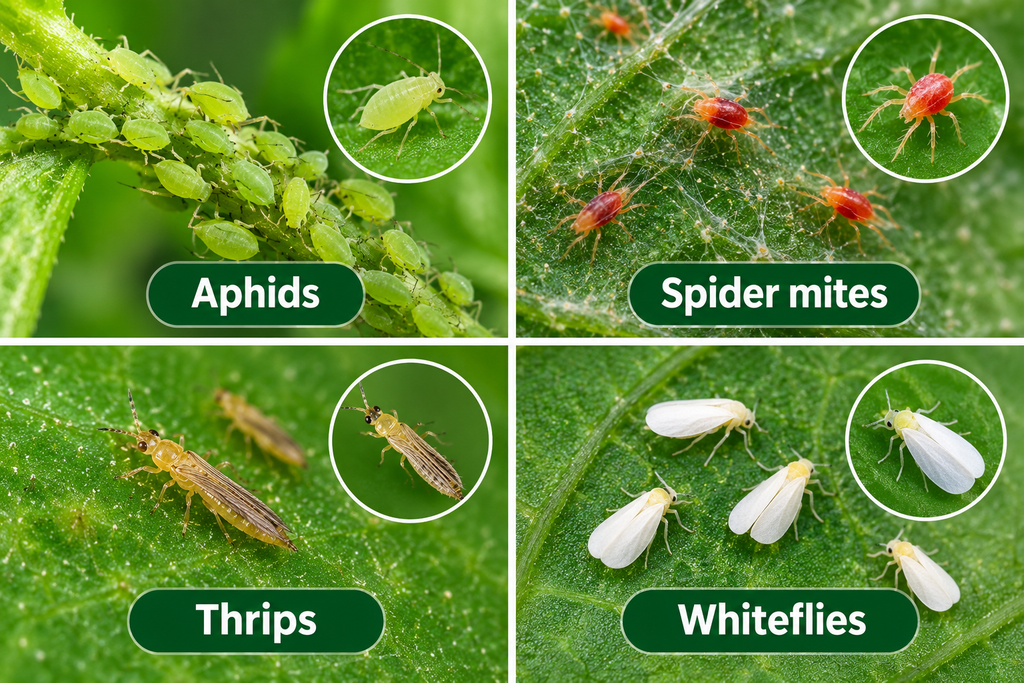
Strawberries can still be affected by insects such as:
Regularly inspect the leaves, stems, flowers, and growing area.
Look underneath leaves because some pests hide there.
Good airflow, cleanliness, healthy plants, and early detection can help reduce problems.
If treatment is required, use only products appropriate and legally approved for the crop and intended use, and follow the label carefully.
Support Your Strawberry Plants
Strawberry plants can become heavy when fruit develops.
Make sure the plant is securely supported by your hydroponic system.
One major advantage of hydroponic growing is that you can position developing fruit so that it hangs away from wet surfaces.
Keeping fruit clean and dry can help reduce the risk of certain fruit-quality problems.
Harvest Strawberries at the Right Time
One of the best parts of growing strawberries at home is harvesting ripe fruit.
Look for berries that have developed their characteristic color and appear mature for the variety.
Harvest carefully without damaging the plant or nearby flowers.
Freshly harvested strawberries can be enjoyed immediately or stored appropriately.
Do not leave overripe fruit on the plant for too long, as damaged or decaying fruit can attract pests.
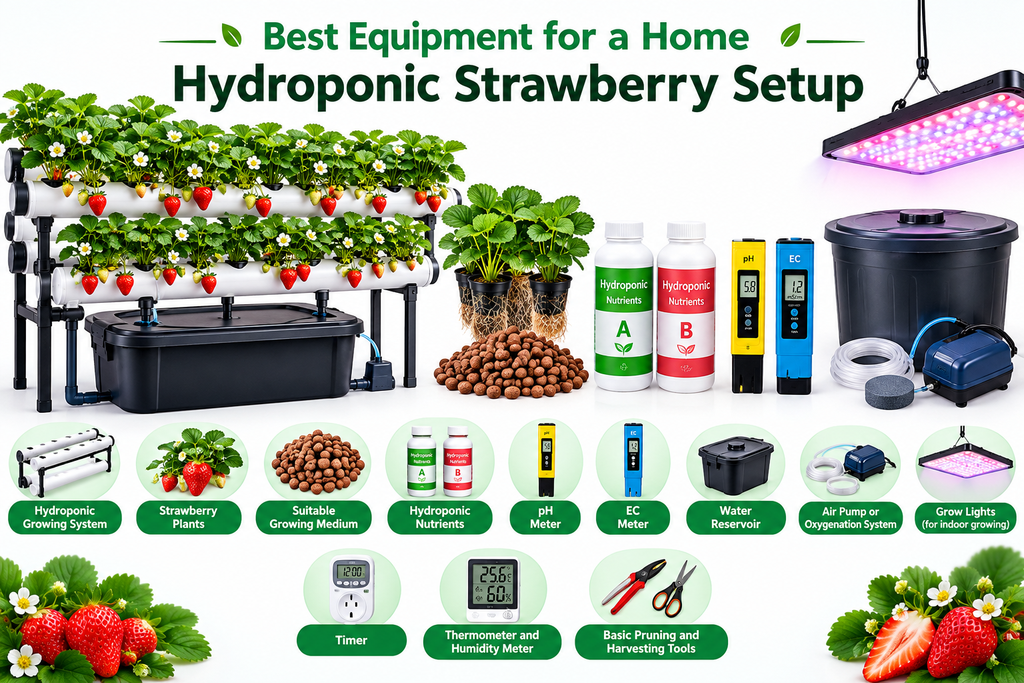
Best Equipment for a Home Hydroponic Strawberry Setup
If you are starting from scratch, you do not necessarily need expensive equipment.
A basic setup may include:
- Hydroponic growing system
- Strawberry plants
- Suitable growing medium
- Hydroponic nutrients
- pH meter
- EC meter
- Water reservoir
- Air pump or suitable oxygenation system, depending on setup
- Grow lights for indoor growing
- Timer
- Thermometer and humidity meter
- Basic pruning and harvesting tools
You can build your system gradually rather than purchasing everything at once.
Recommended Products for Beginners
If you are planning to start growing strawberries at home, we can recommend useful equipment based on your growing space and budget.
Essential
Hydroponic Strawberry Growing System
VIEW SYSTEM → https://link.amazon/B0cWZq8tA
Useful
Digital pH Meter
CHECK PRICE → https://link.amazon/B03oHjKFZ
Useful
Digital EC Meter
CHECK PRICE → https://link.amazon/B0668VTQa
For Indoor Growing
LED Grow Light
VIEW GROW LIGHT → https://link.amazon/B04GOT53s
For Plant Support
Hydroponic Growing Media
VIEW OPTIONS → https://link.amazon/B0aqgYxNR
For Nutrition
Hydroponic Strawberry Nutrients
VIEW NUTRIENTS → https://link.amazon/B02L8VmLf
Affiliate Disclosure: Some links on this page may be affiliate links. If you purchase a product through one of these links, we may earn a small commission at no additional cost to you. We only recommend products that are relevant to hydroponic growing and may be useful to our readers.
Simple Strawberry Growing Routine
A simple routine can make hydroponic strawberry growing much easier.
Every Day
Check:
- Plant appearance
- Water level
- Temperature
- Signs of pests
- Flowers and developing fruit
Several Times a Week
Check:
- pH
- EC
- Root health
- Growing equipment
- Airflow and humidity
Regularly
- Remove dead leaves
- Remove damaged fruit
- Clean growing areas
- Inspect for pests
- Check pumps and tubing
- Record plant growth and harvests
Keeping a simple growing journal can help you understand what works best in your setup.
Can You Really Grow Strawberries Year-Round?
Hydroponics can allow growers to extend the growing season and produce strawberries outside the normal outdoor season.
However, year-round harvests are not guaranteed.
Strawberry production depends on variety, temperature, light, pollination, plant health, and the growing environment.
Indoor systems give growers greater control over these factors, but they also require additional equipment and monitoring.
The goal should be to create stable growing conditions rather than expecting plants to produce fruit continuously without maintenance.
Start Small and Learn
If you are completely new to hydroponics, do not begin with a large commercial-style strawberry farm.
Start with a few plants.
Learn how to:
- Manage nutrient solution
- Measure pH
- Monitor EC
- Maintain the root zone
- Provide suitable lighting
- Encourage pollination
- Identify pests
- Harvest correctly
Once you understand how your plants respond, you can expand your system.
Final Thoughts
Growing fresh strawberries hydroponically at home can be an exciting way to produce your own fruit in a small space.
The key is not simply buying a hydroponic system. You need to understand the complete growing environment.
Give your strawberries suitable light, nutrients, water, oxygen, temperature, humidity, root support, and pollination.
Monitor your plants regularly and make changes carefully.
Start small, learn from each harvest, and improve your system over time.
With patience and consistent care, your home hydroponic garden can become a productive source of fresh strawberries.
Fresh fruit. Small space. Smart growing.